Scroll down to view survey and related information

Survey 1 - Overland flood hazard area regulations

In May 2025, the Government of Alberta released updated Flood Hazard Area (FHA) maps for communities across the province, including Calgary. The updated FHA maps reflect the latest understanding of a 1:100 flood. The province has adopted a new approach to flood hazard area mapping. This approach divides the FHA into four categories (two of which are new) that reflect the level of risk of overland flooding. The City has developed draft proposed regulations aligned to this new mapping and is now seeking public feedback.

How to complete this survey

We suggest starting by learning about your reach of the river, and what changes may be taking place in your community.

  • You can click the ‘Interactive Flood Map’ tab below to open our draft Regulatory Flood Map and zoom to your property.
  • You can click the ‘Flood Hazard Area Map Fact Sheets’ tab below to view the mapping by reach of the river, along with related facts.

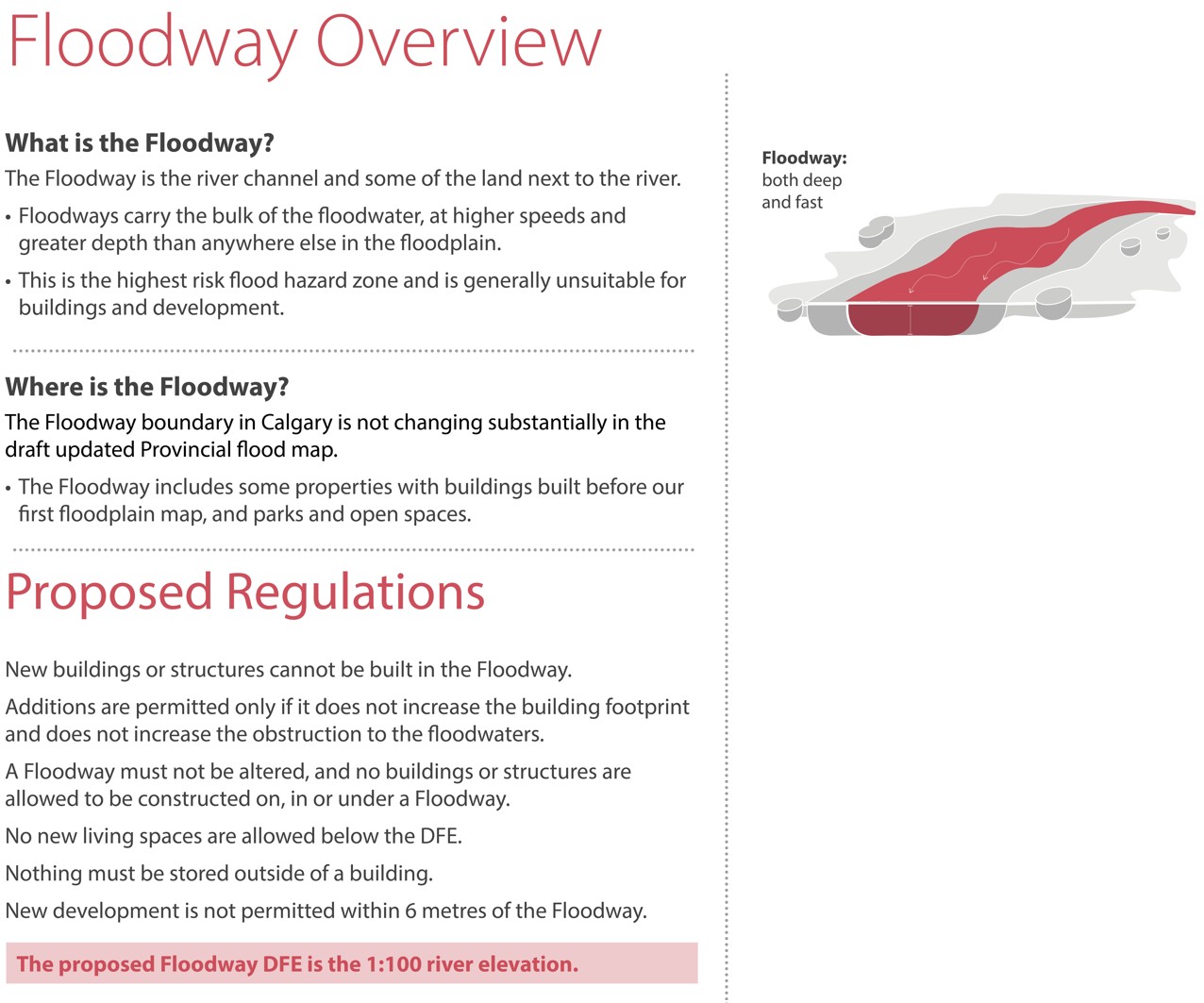
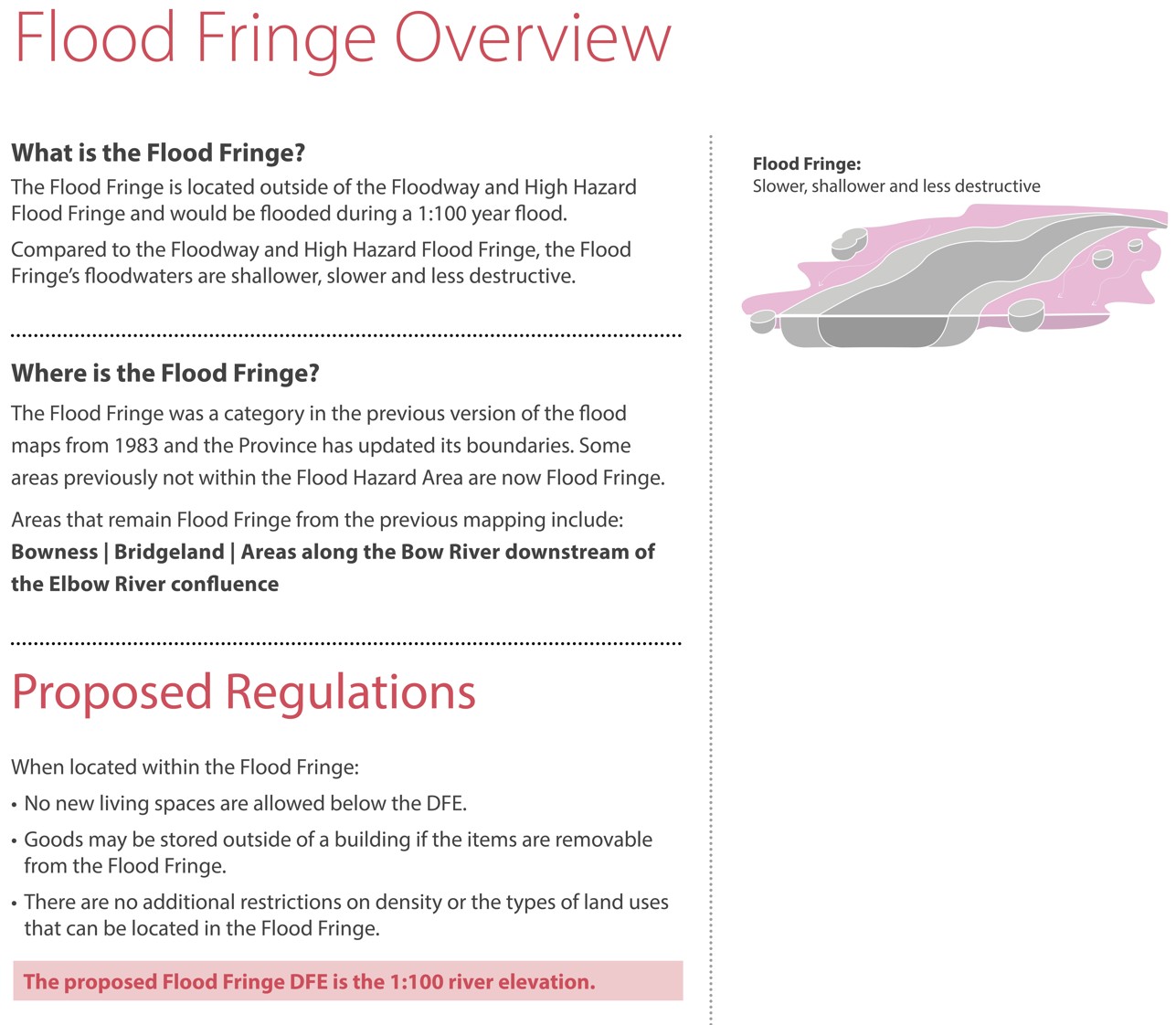
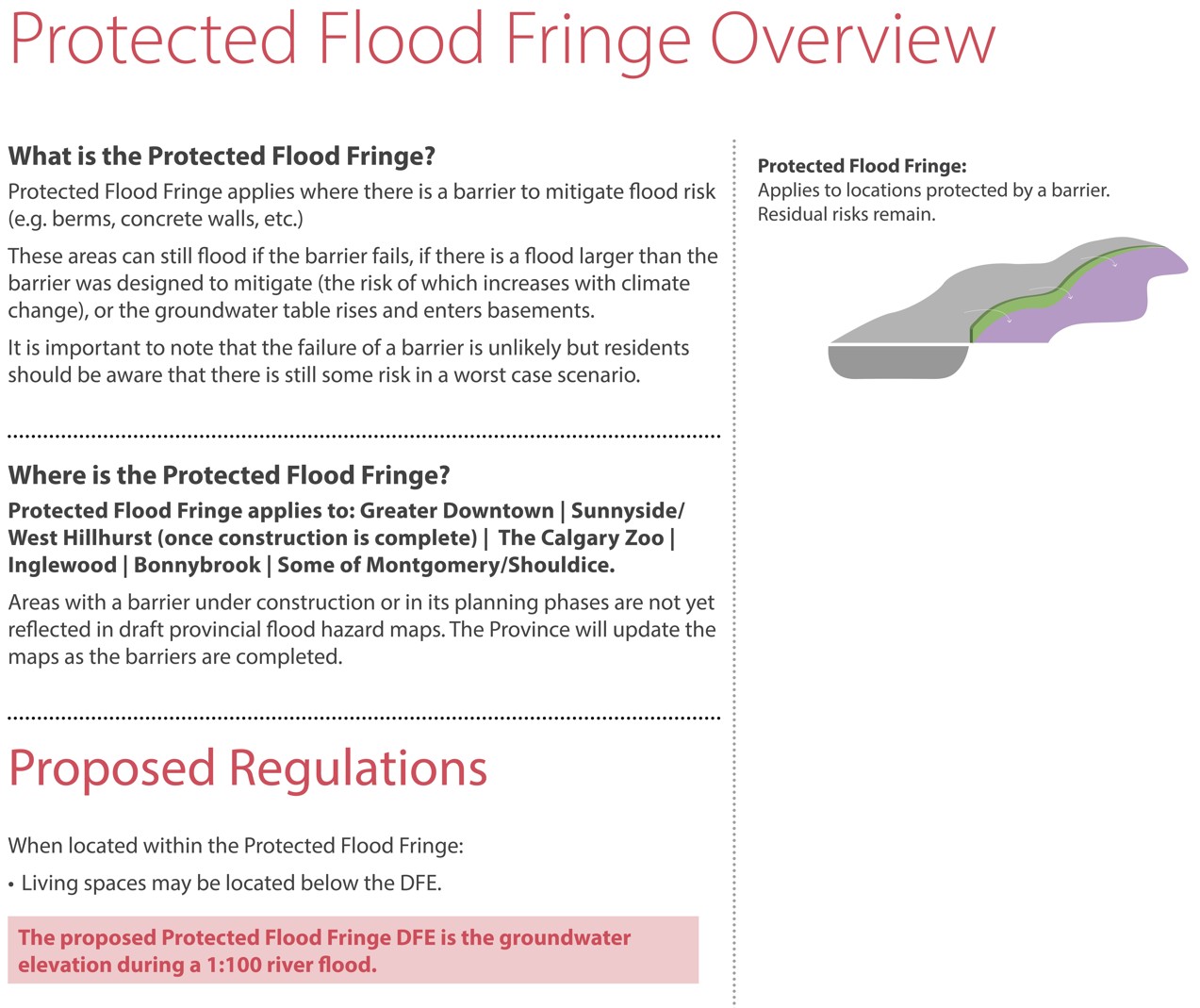
Next, you can learn about the four new hazard areas by clicking the ‘Flood Hazard Areas’ tab, including what it is, and what regulations are being proposed.

Lastly, click the ‘Survey’ tab to answer questions about the proposed regulations.

Interactive flood map

Flood Hazard Area Map Fact Sheets

Flood hazard Areas


Survey 1

We want your opinion! Please complete the questions below to provide your feedback on proposed Flood Hazard Area regulations.

The draft Flood Hazard Area regulations are structured to provide both general building development rules which apply to all Flood Hazard Areas, as well as hazard area specific rules aligned to the area’s risk profile.

All buildings in the flood hazard area must be designed to a Designated Flood Elevation (DFE).

The DFEs proposed for each flood hazard area are:

  • Floodway, High Hazard Flood Fringe, Flood Fringe: the 1:100 river elevation
  • Protected Flood Fringe, Groundwater Flood Fringe: the groundwater elevation during a 1:100 river flood

Building floodproofing measures for all Flood Hazard Areas

The following are the draft building floodproofing measures that would be applied to development in the Flood Hazard Area. Different scales of development trigger different requirements.

Living space” or “occupied space” includes all areas of a building used for dwelling, business or storage of goods that could be damaged during a flood - like bedrooms, living rooms, and commercial spaces. It does not include entryways, crawl spaces, and parking areas.

Existing Development & Small Additions

No requirement. Properties that aren’t changing, or are changing by adding 10% or less of their current footprint, are not required to meet any new regulatory requirements in the Flood Hazard Area.

Moderate Additions (not including private garage)

Moderate Additions (not including private garage)


Partial requirements. For moderate additions, minor floodproofing measures are required:

  • Provide electrical isolation for the whole building through a master switch above the DFE.
  • Install a sewer backup valve.

Major Additions & New Construction

Major Additions & New Construction

Full requirements. For major additions and new builds, full floodproofing measures are required:

  • Construct the first floor at or above the DFE.
  • Locate all living spaces above the DFE, except in Protected Flood Fringe areas.
  • Set all windows, doors, and building entrances above the DFE minus 1 metre, except in Protected Flood Fringe where it is above the DFE.
  • Place all electrical and mechanical equipment above the DFE.
  • Make any areas below the DFE watertight.
  • Install a sewer backflow valve and proper foundation drainage.
  • Install a water alarm in the lowest level of the building.
  • Follow reverse-grade driveway design rules.


Continue to next section

Survey 2 - Groundwater Area Regulations

We appreciate and acknowledge that we live, work, and play on the ancestral and traditional territories of the Blackfoot confederacy, made up of the Siksika, Piikani, Amskaapipiikani and Kainai First Nations; the Îethka Nakoda Wîcastabi First Nations, comprised of the Chiniki, Bearspaw, and Goodstoney First Nations; and the Tsuut’ina First Nation. The City of Calgary is also homeland to the historic Northwest Métis and to the Otipemisiwak Métis Government, Métis Nation Battle River Territory (Nose Hill Métis District 5 and Elbow Métis District 6). We acknowledge all Indigenous people who have made Calgary their home.


You see the results of decisions made by The City of Calgary every day. Get involved and provide your input on City projects and programs. Together we can build a better city.

Contact Us

Have questions or want to learn more about a project, contact us below:

Contact Information
Phone 311 or 403-268-CITY (2489)
Email engage@calgary.ca
Website www.calgary.ca